
More on Madlener

Last summer, I published a piece in The Journal of Tolkien Research on “Josef Madlener’s ‘Der Berggiest’: Not the Origin of Gandalf.” It is freely available here. My point basically was that it was chronologically impossible for a postcard first printed in 1934 to have influenced The Hobbit, and specifically the character Gandalf, whose origin was in the late 1920s, while the manuscript of the bulk of the tale was in existence by early 1933 for C.S. Lewis to be reading it. After that piece was published I had some interesting correspondence with some people, notably Carl F. Hostetter, who suggested better matchings of Madlener’s titles for the six-postcard series “Gestalten aus Märchen und Sage” (Characters from Stories and Legends) with the illustrations themselves. (I had noted that a few of the titles had “questionable associations.”)
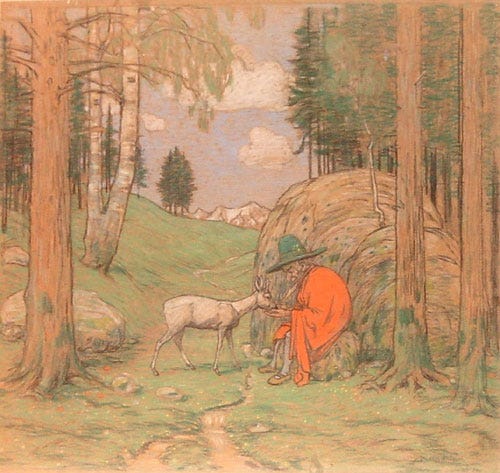
Obviously “Der Berggeist” [The Mountain-spirit”] is correct for the most important piece of art:
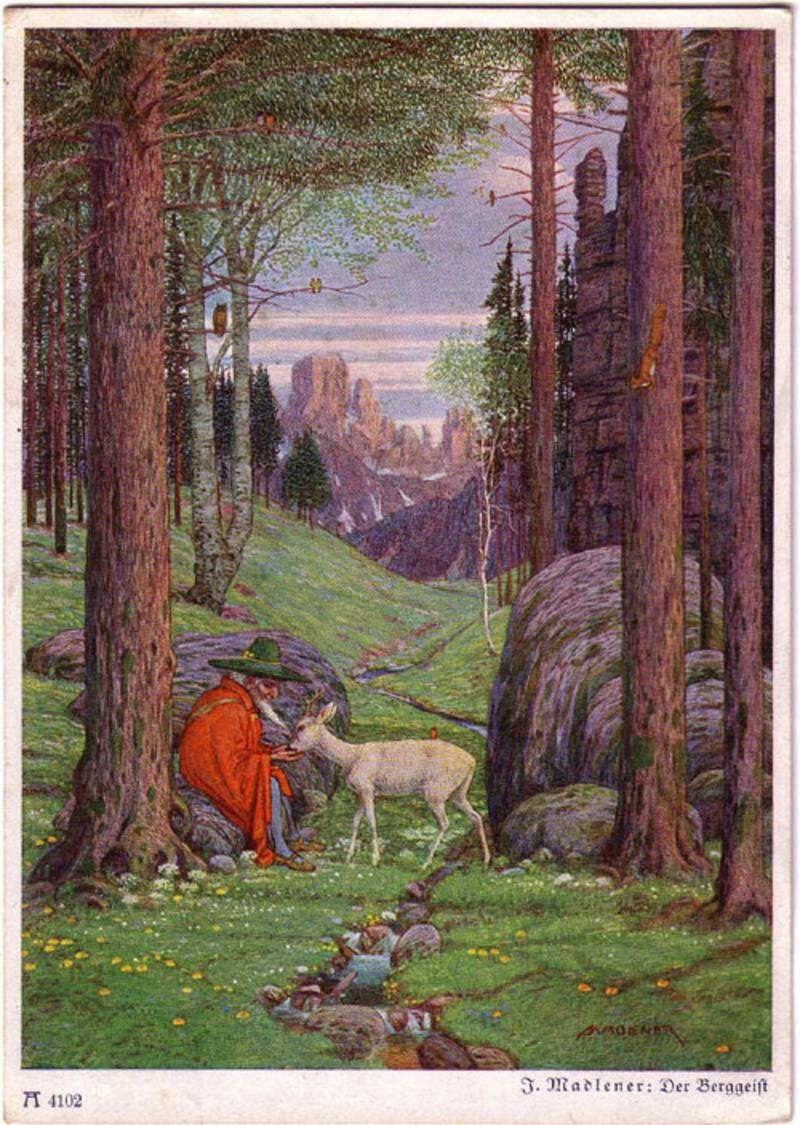
As with most things to do with Tolkien, there are complications with regard to this painting. I will discuss some of them below. Meanwhile I will turn to the other five postcards in the six postcard series
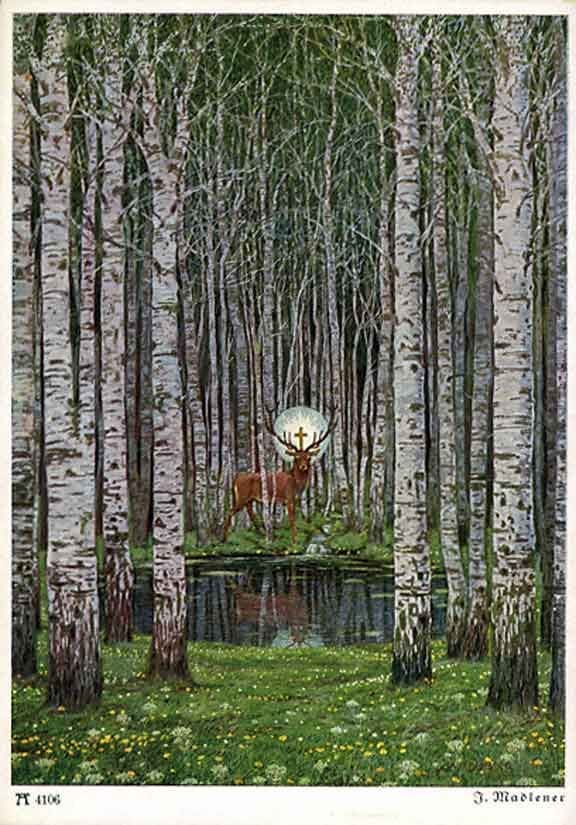
First, I consider two postcards whose identities seem established. “Hubertushirsch” (St. Hubert’s Stag) shows a legendary stag with a glowing cross between its antlers:
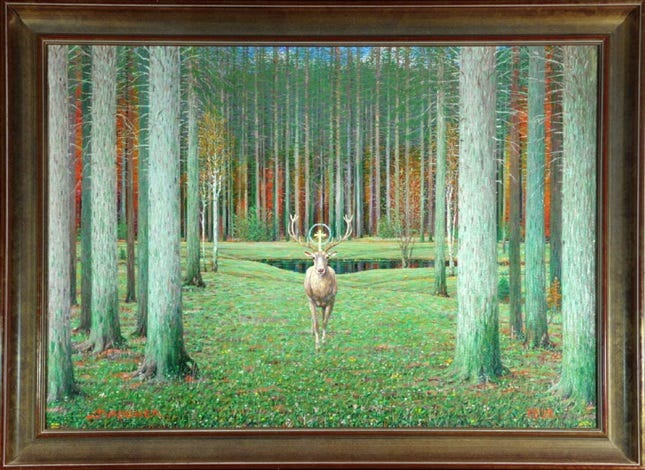
This motif appears in other paintings by Madlener, like this later one from 1953:
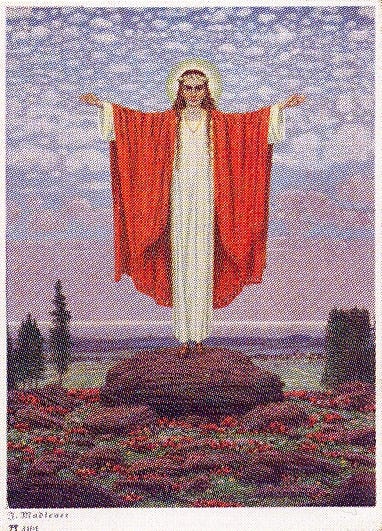
The postcard entitled “Der Frühling” or Springtime seems clearly to be this one, with the flowers ushered forth by the robed apparently male figure (following the masculine gendered article “der”):
(The scans I have of some postcards are not very good, and these are the best reproductions I can manage.)
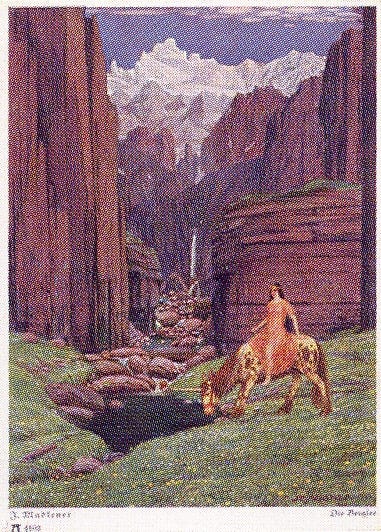
The next of the three remaining postcards is “Die Bergfee”, the Mountain-fairy. With the mountain scenery, I now think this is the correct postcard (though in my previous article I suggested it might be “Rubezahl”). The figure on the horse seem to be female, matching the use of the feminine “die” in the title.
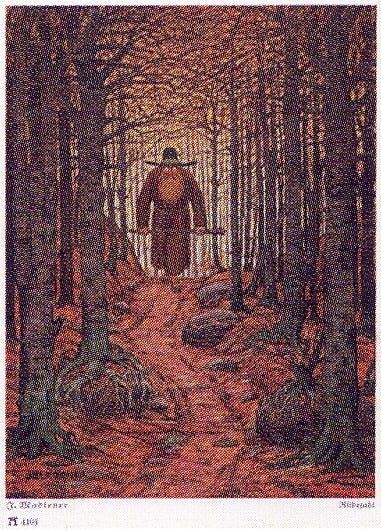
The “Rübezahl,” a legendary mountain spirit of forests in central Europe, seems likely to be the following (which I had tentative identified as “Waldmärchen,” the Forest-fairy). The forest setting and the fact that the creature is holding a staff point more toward it being the Rübezahl.
Finally, there is “Waldmärchen,” the Forest-fairy (which I had suggested might be “Die Bergfee”).
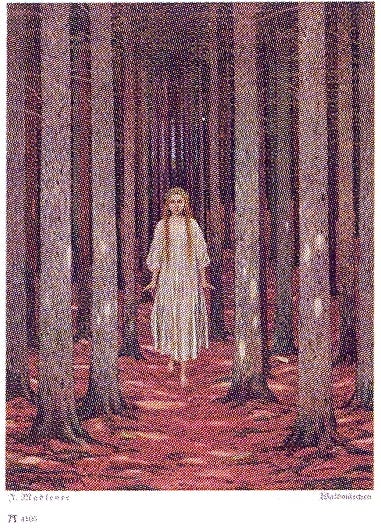
Here the fairy (in a forest) is clearly female, though the German title doesn’t have an article to suggest gender.
To return to “Der Berggeist” I note that the original painting by Madlener surfaced in the U.S. in early 2005, with the owners looking for advice on how to sell it. They noted it was given to their family by Madlener himself in the 1940s, just after the war. It went up for auction at Sotheby’s on 12 July 2005, with the estimate of 20,000 - 30,000 GBP. It sold for 84,000 GBP. Here is the framed original artwork:
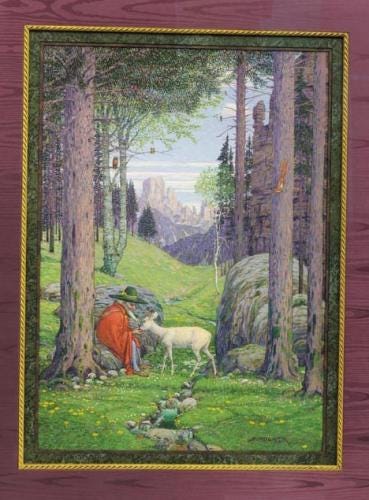
Madlener at some point also did a rough sketch. and this early version is of enough interest to share.
Note how the positioning of the boulders stay the same, while the position of the Berggeist switches, making it better compositionally with the figure on the left side rather than on the right.
One final anecdote about the postcard. Humphrey Carpenter had told me a number of times that he regretted not including the postcard in his Tolkien biography, as he got more queries about it than anything else. When I set about to do the first edition of The Annotated Hobbit in 1988, I was determined to reproduce it. There was a great scramble to find the postcard, and when it finally turned up Rayner Unwin had a transparancy made of it. Thank heavens he had a color transparancy made, because the postcard could not be found when I sought to include it in the 2002 second edition, not remembering that the transparancy was in color. In 1988 we could only reproduce it in black and white, and by the time I was resigned to it appearing again in black-and-white, I dug out the transparancy and was elated to find it in color. The story doesn’t end there. I sent it to Houghton Mifflin, and the day before The Annotated Hobbit was going to press, I got a frantic call that Houghton Mifflin needed the missing illustration. I told them when and to whom it had been sent, and the people at Houghton started searching. That was on a Thursday. They called me on Friday asking me to describe the package in detail, as one person who might have had it was on vacation, and they were going to search his office. After 3 o’clock, I got a jubilant telephone call that the transparancy had been found, and the book was sent to press at 5. Phew! I do not know whether the original postcard was ever found, but at least with the colored version in The Annotated Hobbit, Tolkien-fans have been able to see and appreciate Madlener’s art.